


The 30-Minute Rule: Consistent Pilates Beats Sporadic Workouts
There's a peculiar mindset that grips many of us when it comes to exercise: if you can't do it properly—a full hour, perfectly executed, with complete focus—why bother at all? This all-or-nothing thinking keeps studios empty and bodies stuck in patterns of inactivity, particularly among busy professionals commuting through Wimbledon Station or working from home in Raynes Park.
There's a peculiar mindset that grips many of us when it comes to exercise: if you can't do it properly a full hour, perfectly executed, with complete focus why bother at all? This all-or-nothing thinking keeps studios empty and bodies stuck in patterns of inactivity, particularly among busy professionals commuting through Wimbledon Station or working from home in Raynes Park.
At The Pilates Clinic, we see this thinking regularly. Clients apologise for only having thirty minutes. They skip sessions entirely because they "don't have enough time." They wait for life to calm down before committing to movement. Meanwhile, their bodies accumulate tension, their posture deteriorates, and the gap between where they are and where they want to be widens.
Is 30 minutes of Pilates a day enough?
Yes, for most people. Here's what research and experience in the field consistently demonstrate: thirty minutes of focused Pilates, done regularly, can be remarkably effective. Studies show that Pilates sessions ranging from 30 to 60 minutes, performed 2-3 times weekly, produce measurable improvements in strength, flexibility, and body composition.The American Council on Exercise recommends Pilates practice of 30 minutes, three times weekly, as sufficient to enhance muscle strength, flexibility, and body composition. This matters especially for Pilates beginners who often assume they need lengthy sessions to see progress.
The Problem with Waiting for the Perfect Hour
Modern life doesn't accommodate the luxury of perfect timing. Between work demands, family commitments, and the general chaos of living in South West London, finding a clear sixty-minute window feels increasingly impossible. So we postpone. We tell ourselves we'll start properly when things settle down, when the kids are older, when work calms down, when we move house.
The body doesn't wait. Sitting at a desk for eight hours creates muscular imbalances whether you eventually do Pilates or not. Poor posture compounds daily. The hip flexors tighten, the glutes weaken, the shoulders round forward. Every day of waiting is a day of reinforcing patterns that will take longer to undo.
What many don't realise is that Pilates particularly reformer Pilates is uniquely suited to shorter sessions. Unlike cardiovascular training that requires sustained effort to achieve aerobic benefits, Pilates works through precision and control. Quality matters far more than quantity. Thirty minutes of intelligent, focused movement can address postural issues, activate dormant muscles, and reset tension patterns that have been building all day.
What Happens in Thirty Minutes
At our Wimbledon studio, thirty-minute sessions are structured to be comprehensive rather than rushed. The reformer's adjustable resistance allows exercises to be precisely calibrated, making efficient use of limited time. Here's what occurs:
Minutes 1-5: Arrival and Centering The transition from the outside world into focused movement matters. Whether you've walked from Raynes Park or driven from further afield, those first minutes allow your nervous system to shift from doing mode into sensing mode. Breath awareness begins. You connect to your body rather than simply occupying it.
Minutes 6-20: Targeted Work This is where reformer Pilates shows its efficiency. The springs provide both resistance and assistance, allowing exercises to be precisely calibrated to your body's needs. In fifteen minutes, you can work through fundamental movement patterns: hip extension, spinal articulation, shoulder stabilisation, core integration. Each exercise addresses multiple muscle groups simultaneously when performed correctly.
For Pilates beginners, this focused work is actually ideal. Rather than overwhelming yourself with a complex hour-long sequence, you master fundamental patterns. The body learns better through concentrated repetition than scattered variety.
Minutes 21-25: Integration Movement needs to connect back to daily life. These minutes focus on functional pattern show you get up from a chair, how you reach overhead, how you walk. This is where mat Pilates principles blend with reformer work, translating the strength and awareness you've built into movements you'll use after leaving the studio.
Minutes 26-30: Closure Ending well matters as much as beginning well. Breath work, gentle stretching, and conscious relaxation allow your nervous system to register the work you've done. This isn't wasted time it's the consolidation phase where your body integrates new movement patterns.
The Evidence on Consistency
Research on exercise frequency supports what practitioners observe: regular, moderate training often proves more effective than sporadic intensive sessions. A 2016 meta-analysis on resistance training found that training muscles twice per week produced superior hypertrophic outcomes compared to once weekly training. Studies on Pilates specifically have shown that sessions of 30-60 minutes, performed 2-3 times weekly over 8-12 weeks, lead to improvements in strength, flexibility, balance, and postural control.
Interestingly, research on young sedentary women found that even once-weekly Pilates training over 10 weeks produced significant improvements in skeletal muscle mass, flexibility, balance, core strength, and body awareness. This suggests that some Pilates practice is considerably better than none, though more frequent sessions may accelerate results.
The body adapts to regular stimulus. Pilates done consistently teaches the nervous system new patterns. Those patterns become automatic. Posture improves without conscious effort. Core engagement becomes habitual. This is the real goal not what happens during the session, but how movement intelligence carries into the other 23.5 hours of the day.
For those searching for Pilates studios in the Wimbledon area, this understanding should influence your choice. Look for studios that accommodate realistic schedules rather than insisting on lengthy commitments. The best Pilates practice is the one you'll actually maintain.
Mat Pilates vs Reformer: What Works in Thirty Minutes?
Both mat Pilates and reformer Pilates can be effective in shorter sessions, but they offer different advantages.
Mat Pilates requires no equipment, making it accessible anywhere. The floor provides consistent feedback about body position. For beginners, mat work teaches fundamental principles breathing, core engagement, spinal articulation without the complexity of apparatus. A thirty-minute mat session can be effective, moving through exercises with appropriate modifications.
However, mat work demands more from the body. Without springs to provide assistance or resistance, practitioners work against gravity and their own bodyweight. This can be challenging for people with significant strength deficits or movement limitations.
Reformer Pilates offers adjustability that makes thirty-minute sessions particularly efficient. The springs can assist movements practitioners aren't yet strong enough to do independently, or add resistance when more challenge is needed. This means a single exercise can be adapted precisely to current capacity.
At The Pilates Clinic, reformer sessions maximise this efficiency. Because resistance and support can be adjusted instantly, less time is spent transitioning between difficulty levels and more time is spent working. This proves valuable in shorter sessions where every minute counts.
For most people, particularly those new to Pilates, the reformer provides better results in limited time. The feedback from the springs helps you feel what correct engagement should be like. The carriage movement challenges your stability in ways mat work can't replicate. And the variety of exercises possible on the reformer keeps the practice engaging rather than repetitive.
The Wimbledon Advantage: Proximity and Consistency
One often-overlooked factor in maintaining consistency is simply how close your studio is to your daily routine. We see this constantly clients who live in Raynes Park or work near Wimbledon Village maintain their practice because it fits their actual life, not their idealised version of life.
When your Pilates studio requires a twenty-minute drive or complicated train journey, that thirty-minute session becomes an hour-and-a-half commitment once you factor in travel. The friction increases. Sessions get skipped. The practice fades.
This is why searching for Pilates classes near your home or workplace matters more than finding the "perfect" studio further away. Consistency beats perfection. A good studio you can reach easily will serve you better than an exceptional studio you rarely visit.
What About Longer Sessions?
This isn't to say hour-long Pilates classes have no place. For experienced practitioners, longer sessions allow exploration of more advanced repertoire. If you're training for specific performance goals or working through complex rehabilitation, extended time with your instructor proves valuable. Private sessions often run longer because they're addressing individual needs comprehensively.
But for the majority of people those managing desk jobs, raising families, or simply trying to maintain their bodies amid busy lives the thirty-minute session removes the primary barrier to consistency: time. You can fit it into a lunch break. You can do it before work. You can manage it between school drop-off and the office.
Starting Your Practice
For Pilates beginners wondering where to begin, thirty-minute sessions offer an ideal entry point. The commitment feels manageable. You're not exhausted afterwards. You can maintain conversation and clarity this isn't about depleting yourself but about building awareness and control.
At The Pilates Clinic in Wimbledon, we've designed our class structure around this understanding. We offer reformer Pilates sessions that accommodate real schedules without compromising on quality. Our instructors are trained to maximise what's possible in limited time rather than treating shorter sessions as inferior versions of longer ones.
Whether you're completely new to Pilates or returning after time away, the same principle applies: start where you are, with the time you actually have, and build from there. Your body will respond to consistent, focused work regardless of duration.
The Week That Works
Here's what a realistic, sustainable Pilates practice looks like for someone with genuine time constraints:
- Monday: 30-minute reformer class at lunchtime
- Wednesday: 30-minute mat practice at home in the morning
- Friday: 30-minute reformer class after work
- Weekend: Optional 15-minute mobility routine
That's 105 minutes of Pilates per week. Less than two hours. Entirely achievable for most people. And significantly more effective than waiting until you have time for three hour-long sessions that never actually happen.
Beyond the Studio
The goal of Pilates isn't to become someone who does Pilates. The goal is to become someone who moves well, consistently, throughout their life. Thirty-minute sessions support this better than sporadic longer ones because they keep you connected to your practice without it consuming your schedule.
Movement should support your life, not dominate it. When Pilates fits naturally into your routine a manageable thirty minutes twice or thrice weekly it becomes sustainable. When it requires perfect conditions and extensive time commitments, it becomes another source of stress rather than a solution to it.
Taking the First Step
If you've been waiting for the right time to start Pilates, or if you've let your practice lapse because you "don't have time," consider this your permission to begin with less. Thirty minutes is enough. Twice a week is enough. Starting is enough.
For those in Wimbledon, Raynes Park, Southfields, or surrounding areas, The Pilates Clinic welcomes both experienced practitioners and complete beginners. Our reformer classes are designed for real people with real schedules, not for the imaginary version of yourself with unlimited time and energy.
Book a thirty-minute session. Experience what focused, intelligent movement feels like. Discover that you don't need perfect conditions to begin taking better care of your body. You just need to start.
The body you want strong, mobile, capable isn't built in sporadic marathon sessions. It's built in consistent, manageable increments. Thirty minutes at a time.
Frequently Asked Questions (FAQs)
Is 30 minutes of Pilates a day enough?
Yes. Thirty minutes of focused Pilates, performed consistently, is enough to build core strength, improve flexibility, and support better posture for most people. The American Council on Exercise recommends 30 minutes, three times weekly, as sufficient for measurable results.
How long should a Pilates session be?
Most Pilates sessions run between 30 and 60 minutes. Research shows sessions in this range, done 2-3 times a week, produce measurable improvements in strength, flexibility, and body composition. A well-structured 30-minute session is enough for beginners and for people with limited time.
How long should Pilates sessions last?
A Pilates session should last at least 30 minutes to allow time for warm-up, targeted exercise, and a proper close. Sessions can run up to 60 minutes for more advanced repertoire, but 30 minutes is enough for consistent, sustainable results.
How many times a week should you do Pilates?
Two to three sessions a week is the frequency most consistently linked to visible results. A 2016 meta-analysis on resistance training found twice-weekly training produced better outcomes than once a week, a pattern reflected in Pilates-specific research as well.
Is 30 minutes of Pilates, three times a week, enough?
Yes. This is the frequency and duration most directly supported by the research cited above. It adds up to roughly 90 minutes of Pilates a week, which is realistic to maintain and enough to produce consistent improvements in strength, posture, and flexibility.


Chronic pain and poor sleep often go hand in hand. Research shows that reformer Pilates can help reduce pain, improve movement confidence, and support better sleep quality, helping to break the cycle and improve everyday wellbeing.

Teaching since 2000 First studio in 2002 Opening Wimbledon in 2012 BASI Faculty role Why rehabilitation matters Success stories How Pilates has evolved
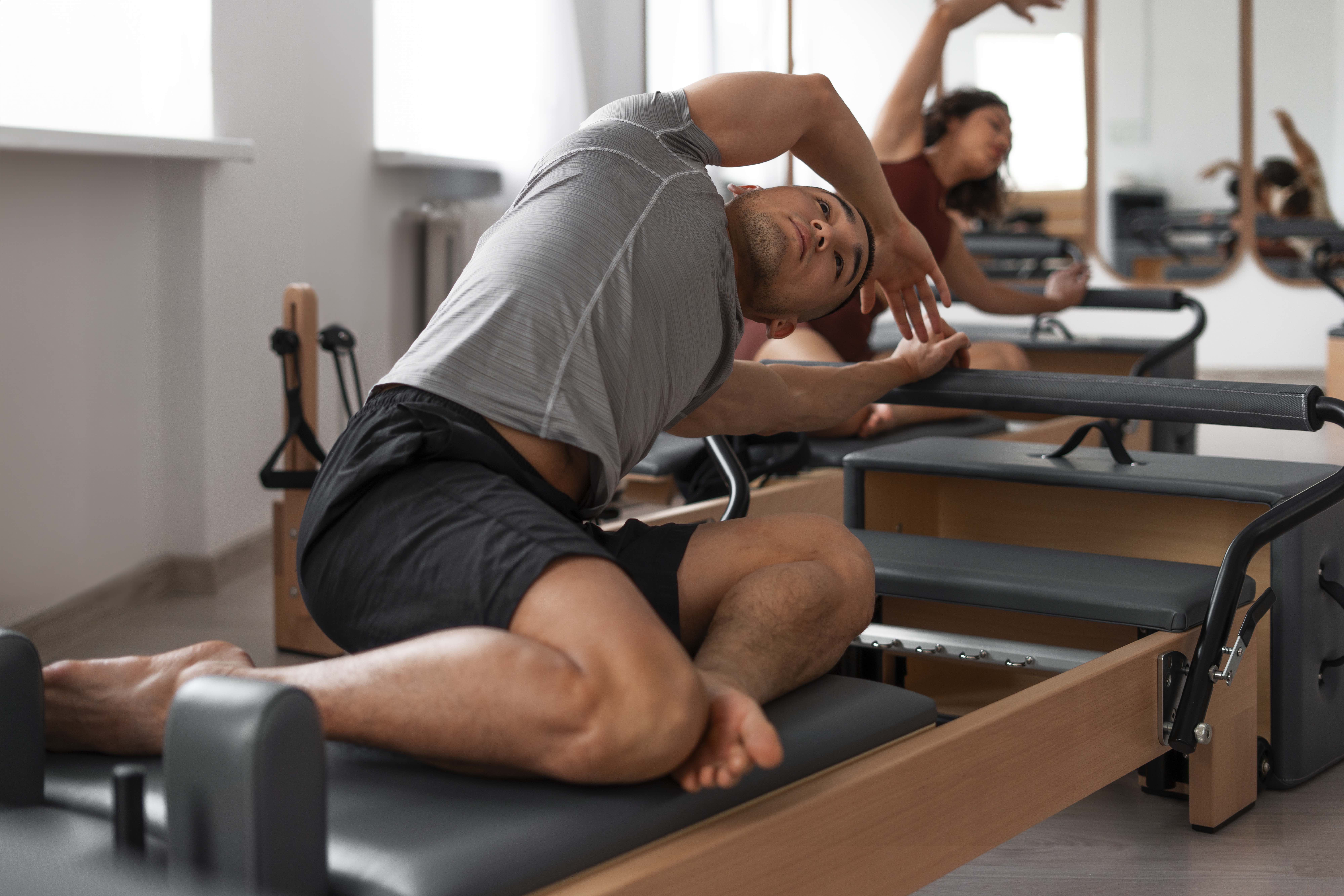
Pilates for men is rapidly shifting from niche to necessity, especially for those dealing with tight hips, back pain, or desk-related stiffness. At The Pilates Clinic in Wimbledon, reformer Pilates for men is used to improve mobility, core strength, and long-term injury resilience—backed by emerging research and real-world clinical results.


Follow us on Social media


