


Post Hip Replacement Conditioning: How Pilates Supports Your Recovery Journey
Hip replacement surgery is one of the most successful orthopaedic procedures performed today. According to the National Joint Registry, which has now recorded over 4 million joint replacement procedures, 2023 saw the highest number of primary total hip replacements performed since the registry began.
Hip replacement surgery is one of the most successful orthopaedic procedures performed today. According to the National Joint Registry, which has now recorded over 4 million joint replacement procedures, 2023 saw the highest number of primary total hip replacements performed since the registry began. For many people, surgery marks the beginning of a pain-free, more active life. But surgery is only half the story. What happens next, how you move, strengthen, and condition your body in the weeks and months that follow, determines how fully you recover.
At The Pilates Clinic in Wimbledon, we work with clients at various stages of post-hip replacement rehabilitation. From those cleared for movement just eight weeks after surgery to individuals looking to restore their strength and confidence a year or more later, Pilates offers a safe, effective, and personalised approach to recovery.
Why Post-Surgery Conditioning Matters
A new hip joint removes the pain, but it does not automatically restore the strength, mobility, or movement patterns your body needs to function well. Years of compensating for a painful hip leaves a legacy: muscles weaken, others tighten, and the way you walk, sit, and move becomes altered. Without targeted conditioning, these imbalances persist, even with a new joint.
The NHS recommends regular exercise as a cornerstone of hip replacement recovery, noting that daily physiotherapy exercises help patients return to most activities within 10 to 12 weeks. However, complete recovery, including the restoration of full strength, balance, and mobility, takes six to twelve months.
This is where Pilates becomes invaluable. Rather than simply repeating isolated exercises, Pilates retrains the entire body to move with control, alignment, and awareness. It addresses not just the hip itself but the core stability, pelvic alignment, and functional strength needed for everyday life.
When Can You Start Pilates After Hip Replacement?
Quick answer: Most people can begin modified Pilates around 8–12 weeks after hip replacement, once cleared by their surgeon or physiotherapist. In the first 6–8 weeks, avoid bending the hip past 90 degrees, crossing the operated leg over the midline, and twisting movements.
Timing matters. In the first six to eight weeks after surgery, your body is healing and specific precautions apply to prevent dislocation. These typically include avoiding bending the hip beyond 90 degrees, not crossing the operated leg over the midline of the body, and avoiding twisting movements.
Once your surgeon or physiotherapist clears you for wider activity, usually around eight to twelve weeks post-surgery, Pilates can begin. Most clients returning to our Wimbledon studio start with private one-to-one sessions, which allow the instructor to assess your movement, understand your precautions, and tailor exercises to your stage of recovery.
A study published in Clinical Orthopaedics and Related Research by Levine, Kaplanek, and Jaffe examined the integration of Pilates training in rehabilitation after hip and knee replacements. The findings indicated that modified Pilates exercises tailored to post-surgical precautions led to improved range of motion, better movement efficiency, and reduced joint stiffness, with no early complications reported.
What Makes Pilates Ideal for Hip Replacement Recovery?
Pilates was designed for rehabilitation. Joseph Pilates originally developed his method to help injured soldiers recover, and its principles translate directly to post-surgical conditioning.
Controlled, Low-Impact Movement
Unlike high-impact exercise, Pilates movements are slow, deliberate, and controlled. This reduces stress on the new joint while still challenging the muscles. Exercises can be adapted to respect any remaining precautions while progressively building strength and mobility.
Core Stability and Pelvic Alignment
The hip joint does not work in isolation. It depends on a stable pelvis and strong core muscles to function efficiently. Pilates prioritises deep core engagement and pelvic stability, which directly supports the hip and improves how you walk, climb stairs, and move through daily life.
Rebuilding Balance and Proprioception
After surgery, many people feel uncertain on their feet. The body's sense of where it is in space, known as proprioception, can be disrupted. Pilates exercises challenge balance in a controlled environment, rebuilding the confidence needed to move safely and reducing the risk of falls.
Correcting Compensation Patterns
Years of hip pain create lasting compensations. You might favour one side when walking, avoid certain movements, or carry tension in your lower back or opposite hip. Pilates addresses these patterns systematically, restoring symmetry and balanced movement.
Strengthening the Muscles Around the Hip
Key muscles such as the glutes, hip abductors, and deep hip stabilisers often weaken before and after surgery. Pilates exercises like bridging, side-lying leg work, and reformer footwork target these muscles specifically, rebuilding the strength needed for stable, pain-free movement.
Exercises That Support Hip Replacement Recovery
While every programme is tailored to the individual, certain Pilates exercises are particularly beneficial after hip replacement. At The Pilates Clinic, we often incorporate the following:
Bridging
Lying on your back with knees bent and feet flat on the floor, you lift the hips while engaging the glutes and core. This strengthens the posterior chain and improves hip extension without placing the joint under load.
Heel Slides and Knee Folds
These gentle movements help restore hip flexion and improve the range of motion in a controlled, supine position. They are often among the first exercises introduced.
Side-Lying Leg Work
Exercises such as clamshells and leg lifts target the hip abductors and external rotators, muscles essential for walking stability and pelvic control.
Standing Balance Work
As recovery progresses, standing exercises challenge balance and weight-bearing through the operated leg. Single-leg stands, weight shifts, and small squats all build functional strength.
Swimming (Prone or Quadruped)
This exercise strengthens the back extensors and glutes while promoting coordinated movement of the arms and legs. It can be modified to avoid hip extension beyond a comfortable range.
Reformer Pilates After Hip Replacement
Quick answer: Reformer Pilates is well suited to hip replacement recovery because the carriage and spring resistance support the body through controlled ranges of motion, making it easier to build strength safely without loading the joint the way standing, unsupported exercise does. Most clients introduce reformer work once cleared for wider activity, typically from around 8–12 weeks post-surgery, and progress the resistance gradually under instructor supervision.
The reformer's supported, sliding carriage makes it a particularly good fit for this stage of rehabilitation, for a few specific reasons:
It removes gravity and impact from the equation. Footwork and leg work performed lying on the carriage lets you strengthen the quadriceps, hamstrings, and glutes without the joint compression that comes from standing exercise, which matters most in the early-to-mid stages of recovery.
Spring resistance is fully adjustable. An instructor can dial resistance up or down within a single session, meaning a client eight weeks post-op and a client eight months post-op can work on the same machine at appropriately different intensities.
It reinforces precise, controlled movement patterns. Because the carriage moves in a single track, reformer work naturally discourages the compensations (hip hiking, rotating through the pelvis, favouring the non-operated side) that are common after surgery, and gives both client and instructor immediate visual feedback when they occur.
Common reformer exercises we introduce during hip replacement recovery include:
- Footwork (supine) — builds baseline strength through the legs and hips in a fully supported position, usually the first reformer exercise introduced.
- Bridging with feet on the footbar — adds resistance to the same bridging pattern used in mat work, progressing hip extension strength.
- Short spine and pelvic curl variations (introduced later, and only once precautions have lifted) — build lumbo-pelvic control that supports the hip through daily movement.
- Standing leg work at the reformer — introduced in later stages to bridge the gap between supported carriage work and unsupported standing strength.
As with all post-surgical work, reformer exercises are sequenced and modified by the instructor based on your specific precautions, surgical approach (posterior, anterior, or lateral), and how your recovery is progressing — this is not a generic reformer class, and we don't recommend jumping into group reformer sessions until your instructor has assessed you one-to-one first.
What to Avoid
Some movements remain unsuitable for an extended period after hip replacement, particularly those involving deep hip flexion, adduction past the midline, or internal rotation. Twisting movements should be avoided until at least twelve weeks post-surgery.
At The Pilates Clinic, our instructors are trained to modify or substitute exercises as needed. Private and semi-private sessions provide the individual attention necessary to ensure safety while still progressing your recovery.
The Long-Term View
Hip replacement is not the end of your movement journey; it is a new beginning. Research published in The Lancet found that approximately 85% of hip replacements last for 15 years, with around 58% lasting 25 years or more. The stronger and more mobile you remain, the better your joint will serve you.
Pilates supports this long-term view. Once the initial rehabilitation phase is complete, usually by twelve months, you can participate fully in classes without specific modifications. Many clients continue practising Pilates for years after their surgery, not because they need rehabilitation but because it helps them feel stronger, more mobile, and more confident in their bodies.
Pilates for Hip Replacement in Wimbledon
At The Pilates Clinic in Wimbledon, we have over 20 years of experience working with clients recovering from orthopaedic surgery, including hip and knee replacements. Our instructors hold BASI Pilates certifications and understand the specific needs and precautions of post-surgical clients.
We recommend beginning with private sessions after clearance from your surgeon or physiotherapist. These sessions allow us to assess your movement, understand your goals, and create a programme that respects your body's current capacity while challenging you to progress.
As you grow stronger and more confident, you may choose to transition to semi-private or group reformer classes. The progression is yours to determine, guided by how your body responds.
Frequently Asked Questions (FAQs)
How soon after hip replacement can I start Pilates?
Most clients begin Pilates eight to twelve weeks after surgery, once cleared by their surgeon or physiotherapist. We always recommend a private session first to assess your movement and tailor exercises to your needs.
Is Pilates safe after hip replacement?
Yes, when guided by a qualified instructor. Research published in Clinical Orthopaedics and Related Research supports Pilates as a safe and effective form of rehabilitation after hip replacement. The key is working with someone who understands post-surgical precautions and can modify exercises appropriately.
Can you do reformer Pilates after a hip replacement?
Yes. Reformer Pilates is often introduced once you're cleared for wider activity, typically from around 8–12 weeks post-surgery, starting with supported, low-resistance exercises like supine footwork before progressing to more advanced work.
Will I need to follow precautions during Pilates?
In the early months, certain precautions such as avoiding deep hip flexion or crossing the leg past the midline may still apply. Your instructor will adapt exercises accordingly. By twelve months, most clients can participate without restrictions.
Can Pilates help if my surgery was a long time ago?
Absolutely. Whether you had your hip replaced six months or six years ago, Pilates can improve strength, mobility, and movement quality. It is never too late to benefit.
Do you offer sessions specifically for post-surgical clients?
We tailor all private and semi-private sessions to individual needs, including post-surgical rehabilitation. Contact us to discuss your situation and book an assessment.
Ready to Begin Your Recovery?
If you have had a hip replacement and want to restore your strength, mobility, and confidence, Pilates offers a proven path forward. At The Pilates Clinic in Wimbledon, we are here to support you at every stage of your recovery.
Book a private session to get started.
The Pilates Clinic is located at 3 Red Studios, Elm Grove, Wimbledon SW19 4BX. We offer private, semi-private, and group Pilates sessions for all levels, including those recovering from surgery or managing chronic conditions. Contact us for more information.


Chronic pain and poor sleep often go hand in hand. Research shows that reformer Pilates can help reduce pain, improve movement confidence, and support better sleep quality, helping to break the cycle and improve everyday wellbeing.

Teaching since 2000 First studio in 2002 Opening Wimbledon in 2012 BASI Faculty role Why rehabilitation matters Success stories How Pilates has evolved
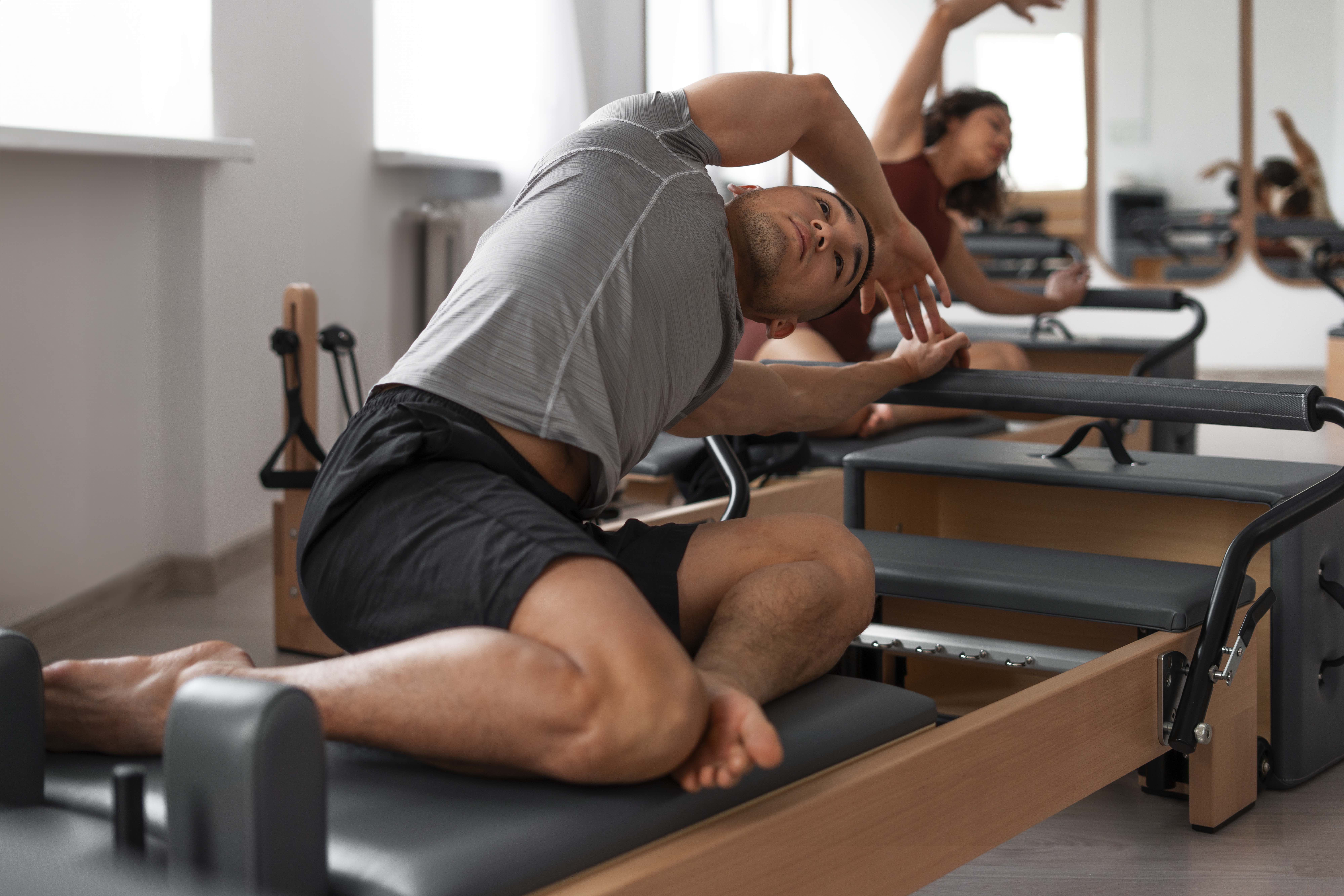
Pilates for men is rapidly shifting from niche to necessity, especially for those dealing with tight hips, back pain, or desk-related stiffness. At The Pilates Clinic in Wimbledon, reformer Pilates for men is used to improve mobility, core strength, and long-term injury resilience—backed by emerging research and real-world clinical results.


Follow us on Social media


